150+
Active emojis
Coded icons across 6 risk tiers.
Executive Insight Report 2026
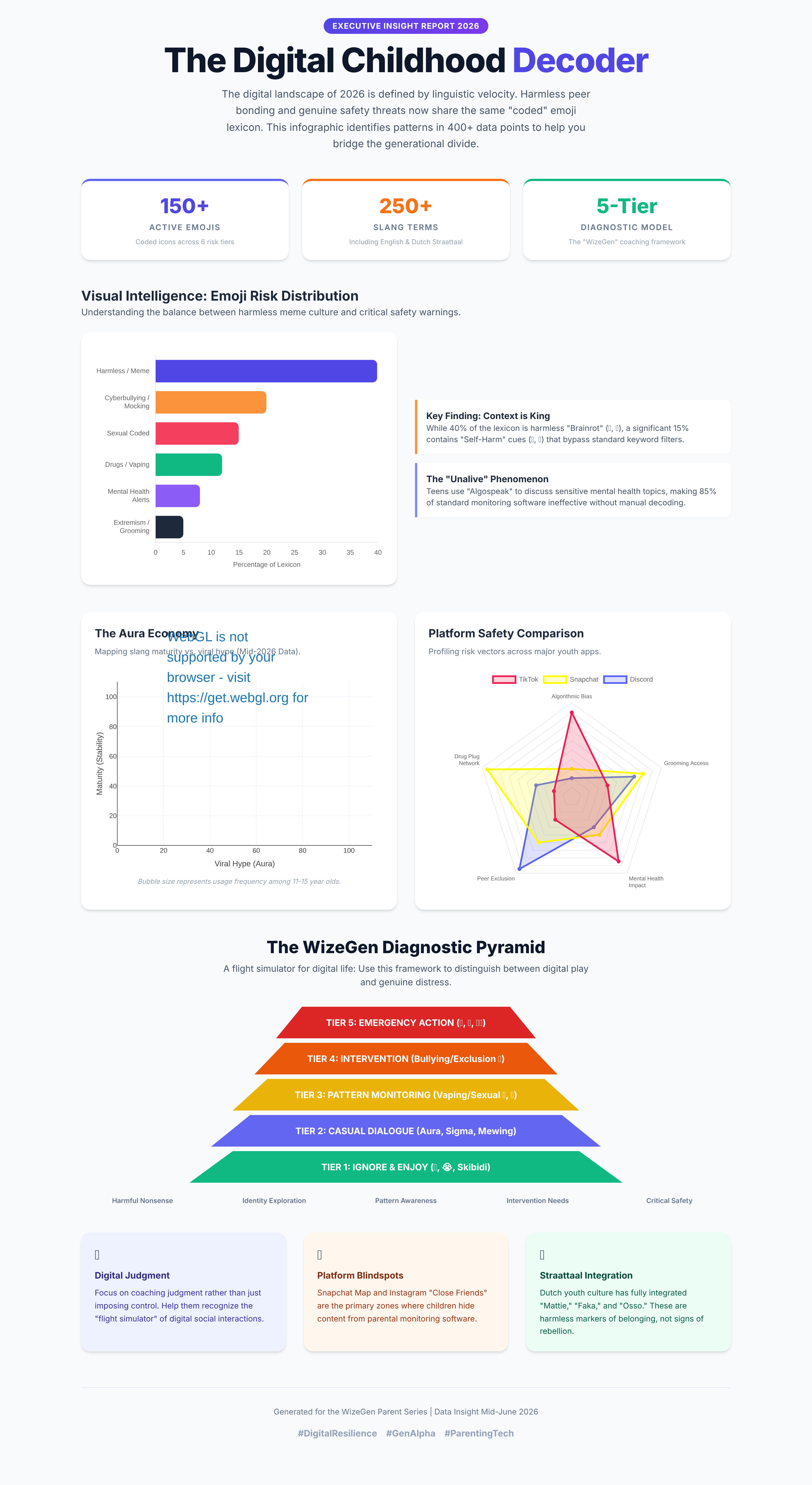
The digital landscape of 2026 is defined by linguistic velocity. Harmless peer bonding and genuine safety threats now share the same coded emoji lexicon. This report identifies patterns in 400+ data points to help you bridge the generational divide.
150+
Active emojis
Coded icons across 6 risk tiers.
250+
Slang terms
Including English and Dutch straattaal.
5-tier
Diagnostic model
The WizeGen coaching framework.
Understanding the balance between harmless meme culture and critical safety warnings.
A coaching framework to distinguish play from distress.
Emergency action
Critical safety signals — immediate response required.
Intervention (bullying / exclusion)
Repeated harm patterns that need a structured conversation.
Pattern monitoring (vaping / sexual)
Watch for recurring themes; coach before escalation.
Casual dialogue (aura, sigma, mewing)
Identity and status language — stay curious, not alarmed.
Ignore & enjoy
Harmless meme culture (e.g. skibidi, 💀, 🤡) — belonging, not rebellion.
Digital judgment
Coach judgment rather than control alone. Help children recognize the "flight simulator" of digital social life.
Platform blindspots
Snap Map and Instagram Close Friends are primary zones where children hide content from parental monitoring.
Straattaal integration
Dutch youth culture has integrated terms like Mattie, Faka, and Osso — harmless markers of belonging, not signs of rebellion.
Generated for the WizeGen Parent Series · Data insight mid-June 2026 · #DigitalResilience #GenAlpha #ParentingTech